Achieving restaurant-quality French fries at home is possible and rewarding, especially with a deep fryer. The key to perfect fries lies in selecting high-starch Russet potatoes, using a high smoke point oil like peanut or canola, and mastering the double-fry technique. This method involves an initial blanching at 300-325°F (149-163°C) for 3-7 minutes, followed by a crucial rest period, and a final crisping fry at 350-375°F (177-190°C) for 2-4 minutes.
The Foundation of Flavor: Understanding French Fries
What Makes a French Fry “Perfect”?
A perfect French fry balances several key characteristics. It features a remarkably crispy exterior that audibly breaks with each bite, giving way to an incredibly soft, light, and fluffy interior that is never dry or mushy. Visually, the ideal fry is a beautiful golden brown, cooked evenly without burnt spots or pallid patches. Finally, it should be perfectly seasoned, typically with fine sea salt, enhancing its natural potato flavor without being overpowering.
Anatomy of a French Fry: How Deep Frying Works
Deep frying transforms a simple potato through a fascinating interplay of starch, water, and hot oil. Potatoes are primarily composed of starch and water. When submerged in hot oil, the water rapidly evaporates, creating steam that pushes outwards, forming a crispy crust. The starch within the potato gelatinizes, contributing to the fluffy texture. The Maillard reaction, a chemical process between amino acids and reducing sugars, is responsible for the fries’ desirable golden-brown color and complex flavor. The secret to a superior fry often lies in the “double-fry” technique, which manages these processes in two distinct stages to achieve the ultimate crispy-fluffy contrast.
Essential Gear & Ingredients for Superior Fries
Crafting the perfect French fry begins with selecting the right components and tools for the job. Each element plays a crucial role in the final texture and taste.
Choosing the Right Potatoes
The foundation of an excellent French fry is the potato itself. Not all potatoes are created equal when it comes to deep frying, and making the right choice is paramount.
- Russet potatoes: These are the undisputed champions for French fries. Their high starch content and low moisture are ideal for achieving that desirable crispy exterior and a wonderfully fluffy interior. The starch contributes to the crispness, while the low moisture prevents them from becoming soggy.
- Alternatives: If Russets aren’t available, varieties like Kennebec and Yukon Gold can also produce good results, though Yukon Golds tend to yield a slightly creamier fry.
- Potatoes to avoid: Steer clear of waxy potatoes such as red potatoes, new potatoes, or fingerlings. Their high moisture and sugar content mean they brown too quickly on the outside before cooking through, often resulting in soggy or hollow fries.
- Storage tips: For optimal frying, select potatoes that have been stored above 40°F (4.4°C). Colder temperatures can cause potato starch to convert into sugar, leading to premature browning during frying.
Selecting Your Frying Oil
|
Our Picks for the Best Deep Fryer in 2026
As an Amazon Associate I earn from qualifying purchases.
|
||
| Num | Product | Action |
|---|---|---|
| 1 | Secura 4 Liters / 17-Cup Stainless-Steel 1700-Watt Electric Deep Fryer with Timer Free Extra Odor Filter, Triple Basket, 4.5 Quarts, Silver |

|
| 2 | West Bend Deep Fryer with Adjustable Temperature Control Nonstick Basket Easy-View Window and Temperature Guide, Folding Handle and Locking Cover for Easy Storage, 3-Liter, Silver |
|
| 3 | Hamilton Beach Electric Deep Fryer with 3 Baskets and Lid, 4.5 Liters / 19 Cups Oil Capacity, Temperature Control, View Window, Professional Style, 1800 Watts, Stainless Steel (35034) |
|
| 4 | Elite Gourmet Electric Deep Fryer, 4.5 Qt Total Oil Capacity (Dual 2-Qt Split Baskets), 1700 Watts, Stainless Steel, Separates Foods for Simultaneous Cooking, Stainless Steel |
|
| 5 | Chefman 4.5 Liter Deep Fryer w/Basket Strainer, XL Jumbo Size, Adjustable Temperature & Timer, Perfect for Fried Chicken, Shrimp, French Fries, Chips & More, Removable Oil-Container, Stainless Steel |
|
| 6 | Alpha Living Electric Deep Fryer – 4.5L Deep Fryer with Basket with 2-Quart and 4-Quart Baskets – High-Grade Stainless Steel – Temperature Control and Timer – Ideal for Fried Chicken, Fries |
|
| 7 | Hamilton Beach Cool Touch Electric Deep Fryer with Basket and Lid, 2 Liters / 8 Cups Oil Capacity, Adjustable Temperature, 1500 Watts for Fast Heat-up, viewing Window Easy to Clean, Black (35021) |
|
| 8 | Hamilton Beach 35032 Professional Style Electric Deep Fryer, Frying Basket with Hooks, 1500 Watts, 3 Liters, Stainless Steel |
|
| 9 | Secura 4 Liters / 17-Cup Stainless-Steel 1700-Watt Electric Deep Fryer with Timer Free Extra Odor Filter, Triple Basket, 4.5 Quarts, Black |
|
| 10 | T-fal 3.5L Stainless Steel Deep Fryer with Basket for Home Use, 1700W, Deep Fryer with Oil Filtration, Temp Control, Digital Timer |
|
The type of oil you use significantly impacts the flavor, texture, and even the healthfulness of your fries. The key is to choose an oil with a high smoke point and a neutral flavor.
- High smoke point, neutral flavor: Excellent choices include peanut oil, canola oil, vegetable oil, sunflower oil, and grapeseed oil. These oils can withstand the high temperatures required for deep frying without breaking down or imparting undesirable flavors. Beef tallow or lard are also traditional options that add a rich, savory depth of flavor.
- Oils to avoid: Avoid oils with low smoke points or strong flavors. Olive oil (especially extra virgin) has a low smoke point and will burn easily. Sesame oil and coconut oil have very distinctive flavors that can overpower the delicate taste of the potato.
- Importance of fresh oil: Always start with fresh, clean oil. Reusing oil too many times or not filtering it properly can lead to off-flavors, unpleasant odors, and can compromise the crispiness of your fries. Old oil tends to degrade, potentially creating unhealthy compounds.
Your Deep Fryer: A Kitchen Essential
While deep frying can be done in a heavy-bottomed pot, a dedicated deep fryer offers unparalleled control and convenience.
- Importance of temperature control: The most significant advantage of a deep fryer is its ability to maintain a consistent oil temperature. Many models come with built-in thermostats and digital controls, which are crucial for the precise temperature management required for perfect French fries. If using a pot, an external clip-on thermometer is indispensable.
- Deep fryer capacity and batch frying: Be mindful of your deep fryer’s capacity. Overcrowding the basket with too many fries at once will drastically drop the oil temperature, leading to soggy, greasy results. Frying in smaller batches is key to maintaining consistent temperature and achieving even cooking and crispiness.
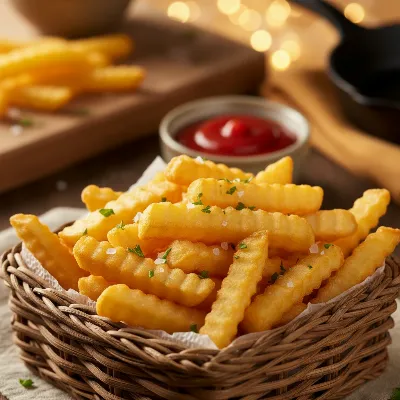 Perfectly golden-brown crispy French fries in a rustic basket with ketchup, highlighting texture
The Step-by-Step Guide to Flawless Deep-Fried French Fries
Achieving the perfect French fry is a process that demands attention to detail at every stage. Follow these steps meticulously, and you’ll be rewarded with fries that rival your favorite restaurant.
Preparation: The Unsung Heroes of Crispy Fries
Proper preparation before frying is just as important as the frying itself. These initial steps lay the groundwork for ultimate crispness.
- Washing & Peeling: Begin by thoroughly washing your Russet potatoes under cool, clean water. While peeling is optional (some prefer the rustic look and added fiber of skin-on fries), for classic, uniformly golden fries, it’s best to peel them.
- Cutting: Uniformity is key to even cooking. Slice your potatoes into consistent sticks, ideally ¼ to ½ inch thick. A mandoline or a French fry cutter can ensure precision, but a sharp chef’s knife and a steady hand work just as well. Uneven cuts will result in some fries being burnt while others remain undercooked.
- Soaking: This is a critical step. Place your cut potato sticks in a large bowl of cold water, or even an ice bath, for at least 30 minutes, and ideally for 2 to 12 hours (some recommend up to 24 hours in the refrigerator). Soaking helps to remove excess surface starch, which prevents the fries from browning too quickly and allows them to crisp up better.
- Thorough Drying: After soaking, drain the potatoes completely and spread them out on a clean kitchen towel or several layers of paper towels. Pat them as dry as possible. Excess moisture is the enemy of crispy fries, causing the oil to splatter violently and resulting in soggy, greasy fries. You want them as dry as possible before they hit the hot oil.
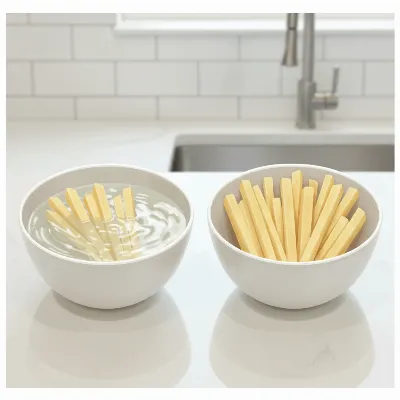 Uniformly cut Russet potato sticks soaking in water, next to dried sticks
The Double-Fry Technique: The Secret to Crispy Perfection
The double-fry method is what truly elevates homemade fries from good to extraordinary. It involves two distinct frying stages at different temperatures.
- First Fry (Blanching/Par-cooking):
- Oil temperature: Preheat your deep fryer to 300°F (149°C) to 325°F (163°C). Use a thermometer to ensure accuracy.
- Cooking time: Carefully lower a batch of thoroughly dried potatoes into the hot oil. Fry for about 3-7 minutes, depending on thickness, until they are limp, cooked through, and slightly softened, but crucially, still pale with no browning.
- Purpose: This initial fry gently cooks the interior of the potato, making it tender and fluffy.
- Batch frying: Always fry in small batches. Do not overcrowd the basket, as this will significantly drop the oil temperature and prevent even cooking.
- The Crucial Rest Period:
- Why it’s important: After the first fry, remove the fries from the oil and place them on a wire rack set over a baking sheet to drain excess oil. Allow them to cool completely. This resting period is vital; it allows moisture within the potato to redistribute and evaporate from the surface, setting the stage for maximum crispness in the second fry.
- How long: Allow at least 10-15 minutes of resting time, but you can rest them for several hours, or even refrigerate them overnight. The colder and drier they are, the crisper they’ll get.
- Draining: The wire rack ensures air circulation, preventing them from steaming and becoming soggy.
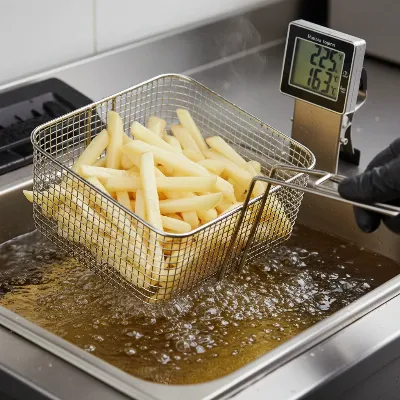 Deep fryer with thermometer at 325°F, lifting pale par-cooked fries
- Second Fry (Finishing):
- Oil temperature: Increase the deep fryer temperature to 350°F (177°C) to 375°F (190°C).
- Cooking time: Once the oil is at the higher temperature, return the cooled, par-cooked fries to the basket in small batches. Fry for another 2-4 minutes, or until they reach a beautiful golden brown color and are wonderfully crispy.
- Purpose: This high-heat, shorter fry quickly crisps the exterior, locking in the fluffy interior achieved in the first fry.
- Batch frying: Again, work in small batches to maintain the oil temperature and ensure even crisping.
- Immediate Seasoning:
- As soon as the fries are removed from the second fry, place them on a clean paper-towel-lined plate or bowl to drain any final excess oil. Immediately sprinkle them generously with fine sea salt. The residual hot oil on the fries will help the salt adhere perfectly. You can also add other seasonings like garlic powder, paprika, or your favorite fry seasoning blend.
- Serve promptly to enjoy them at their peak crispness.
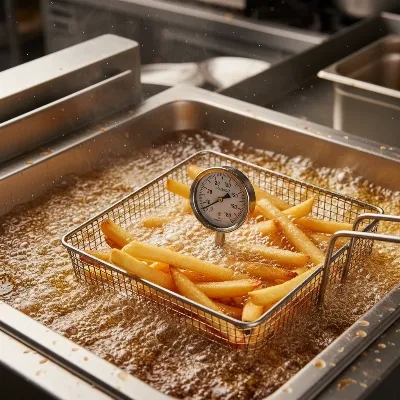 Deep fryer at 375°F with basket of golden fries for final crisping
Troubleshooting Common Deep Fryer French Fry Problems
Even with the best intentions, things can sometimes go awry. Here’s how to identify and fix common issues.
Soggy or Greasy Fries
This is perhaps the most common frustration.
- Too low oil temperature: If the oil isn’t hot enough, the fries will absorb too much oil instead of crisping, leading to a greasy, limp result. Always use a thermometer and ensure the oil is at the correct temperature for each fry stage.
- Overcrowding: Dumping too many fries into the fryer at once causes a significant drop in oil temperature. This leads to the same problem as too-low oil temperature. Fry in smaller batches.
- Insufficient drying: If the potato sticks are still wet when they hit the oil, the excess moisture will steam the fries rather than fry them, resulting in a soggy texture. Always pat them thoroughly dry.
Burnt Outside, Raw Inside
This issue indicates a problem with temperature or potato choice.
- Too high oil temperature (first fry): If your initial fry is too hot, the exterior will brown rapidly before the interior has a chance to cook through. Stick to the lower temperature for the first fry.
- Waxy potatoes: As discussed, waxy potatoes have high sugar content and brown quickly. Always opt for starchy Russets.
- Uneven cuts: Inconsistent potato stick sizes mean thinner fries burn while thicker ones remain undercooked. Aim for uniform thickness.
Lack of Flavor
Bland fries are a missed opportunity.
- Old oil: If you’re reusing oil that’s past its prime, it can impart an unpleasant flavor or simply lack the clean taste needed for good fries.
- Insufficient seasoning: to salt immediately after the second fry while the fries are still hot and slightly oily. This ensures the salt adheres and enhances the flavor. Don’t be shy with seasoning.
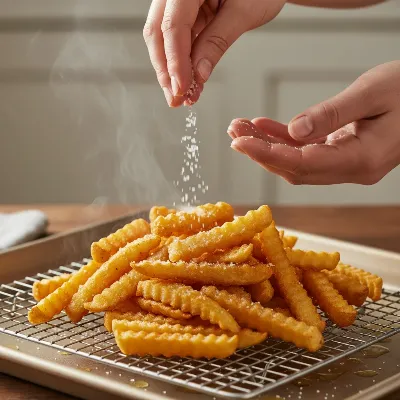 Hands sprinkling sea salt on hot, golden French fries
Tips for Deep Fryer Maintenance and Safety
A deep fryer is a powerful tool, and proper maintenance and safety practices are essential for delicious results and a safe kitchen.
Cleaning Your Deep Fryer
- Regular oil filtration/replacement: For optimal flavor and longevity of your oil, filter it after every use once it has cooled. Replace the oil entirely after 5-10 uses, depending on what you’ve fried. Old oil degrades and can impart off-flavors.
- Cleaning methods: Always unplug and allow the fryer to cool completely before cleaning. Follow your manufacturer’s instructions for disassembling and cleaning the components. Most parts can be washed with warm, soapy water.
Safety First!
- Never leave unattended: Hot oil is a fire hazard. Never leave a deep fryer or a pot of hot oil unattended.
- Proper handling of hot oil: Always lower food gently into hot oil to prevent splattering. Never add wet food to hot oil, as moisture can cause violent splattering.
- Fire safety: Keep a fire extinguisher (Class K for kitchen fires) nearby. Never use water to extinguish an oil fire; it will only make it worse. If an oil fire occurs, turn off the heat and cover the pot with a metal lid or baking sheet if safe to do so.
Expert Insight
“The magic of perfect French fries truly lies in understanding the potato’s nature and respecting the oil’s temperature. The double-fry isn’t just a technique; it’s a scientific method for achieving that coveted textural contrast.”
Conclusion
Creating perfect French fries in your deep fryer is an incredibly rewarding culinary endeavor. By understanding the critical role of potato selection, choosing the right oil, and meticulously following the double-fry technique with precise temperature control, you can consistently produce fries that are crispy, golden, and exquisitely fluffy on the inside. Don’t be discouraged by initial challenges; practice and attention to detail will improve your homemade fries into a consistent triumph. So, embrace your inner fry master, experiment with seasonings, and delight in the irresistible satisfaction of a truly flawless batch. What’s your secret ingredient for elevating your French fry game?
Frequently Asked Questions
Why do my homemade French fries turn out soggy?
Soggy fries are usually caused by too low oil temperature, overcrowding the fryer basket, or insufficient drying of the potatoes before frying. Ensuring your oil is at the correct temperature, frying in small batches, and thoroughly patting your potato sticks dry will help achieve maximum crispness.
Can I reuse the oil for frying French fries?
Yes, you can reuse frying oil, typically 5-10 times, depending on the type of oil and what you’ve fried. It’s crucial to strain the oil through a fine-mesh sieve or cheesecloth after each use to remove food particles. Store it in an airtight container in a cool, dark place.
What’s the ideal thickness for French fries?
For classic French fries, an ideal thickness is typically between 1/4 inch and 1/2 inch. Uniformity in thickness is more important than exact size, as it ensures all fries cook evenly, preventing some from burning while others remain undercooked.
How long can I soak potatoes for before frying?
You should soak cut potato sticks in cold water for at least 30 minutes to remove excess starch. For even better results and maximum crispness, you can soak them in an ice bath for 2 to 12 hours, or even up to 24 hours in the refrigerator, changing the water if soaking for extended periods.
Is parboiling potatoes necessary for good fries?
While not strictly “necessary” if you follow the double-fry method with soaking and drying, some chefs advocate for a quick parboil (briefly boiling the potato sticks before frying). This step can help create a rougher surface texture that promotes crispiness and ensures the interior is partially cooked before frying.
Make Flawless Deep-Fried French Fries
Achieve restaurant-quality French fries at home using a deep fryer and the double-fry technique.
Wash and peel Russet potatoes, then cut them into uniform u00bc to u00bd inch thick sticks. Soak the cut potatoes in cold water for at least 30 minutes, or up to 12 hours, to remove excess starch. Thoroughly pat the potato sticks dry with a clean towel before frying.
Preheat your deep fryer to 300-325u00b0F (149-163u00b0C). Carefully lower small batches of dried potatoes into the hot oil and fry for 3-7 minutes until they are limp and pale, but not browned. This step cooks the interior of the potato.
Remove the par-cooked fries from the oil and place them on a wire rack over a baking sheet to drain excess oil. Allow them to cool completely for at least 10-15 minutes. This crucial resting period allows moisture to redistribute and evaporate, preparing them for maximum crispness.
Increase the deep fryer temperature to 350-375u00b0F (177-190u00b0C). Return the cooled, par-cooked fries to the basket in small batches. Fry for another 2-4 minutes until they achieve a beautiful golden brown color and are wonderfully crispy.
Immediately remove the golden fries from the oil and place them on a paper-towel-lined plate or bowl to drain any final excess oil. Generously sprinkle with fine sea salt while still hot. Serve promptly to enjoy them at their peak crispness.

I appreciated the emphasis on using a high smoke point oil like peanut or canola. I usually just grab whatever’s cheapest, but switching to peanut oil really did seem to improve the overall flavor and crispness without any weird aftertaste. The detailed temperature ranges for each fry stage were super useful.
The tips for oil temperature were helpful, especially the 350-375°F for the second fry. However, I found that my fries still came out a little darker than I wanted, even with careful timing. Maybe my deep fryer runs a bit hot, or I need to cut them thinner next time. Still, they tasted good.
I’ve always struggled to get my homemade fries truly crispy, but the double-fry technique mentioned here is a game-changer. Using Russet potatoes and that initial blanching really made a difference. My family said these were the best fries I’ve ever made, even better than some restaurant ones!
Finally, perfect fries at home! I followed the steps exactly, focusing on the rest period between the two frying stages, and it made all the difference. My fries were golden brown, super crispy on the outside, and wonderfully fluffy inside. This is definitely my new go-to method.