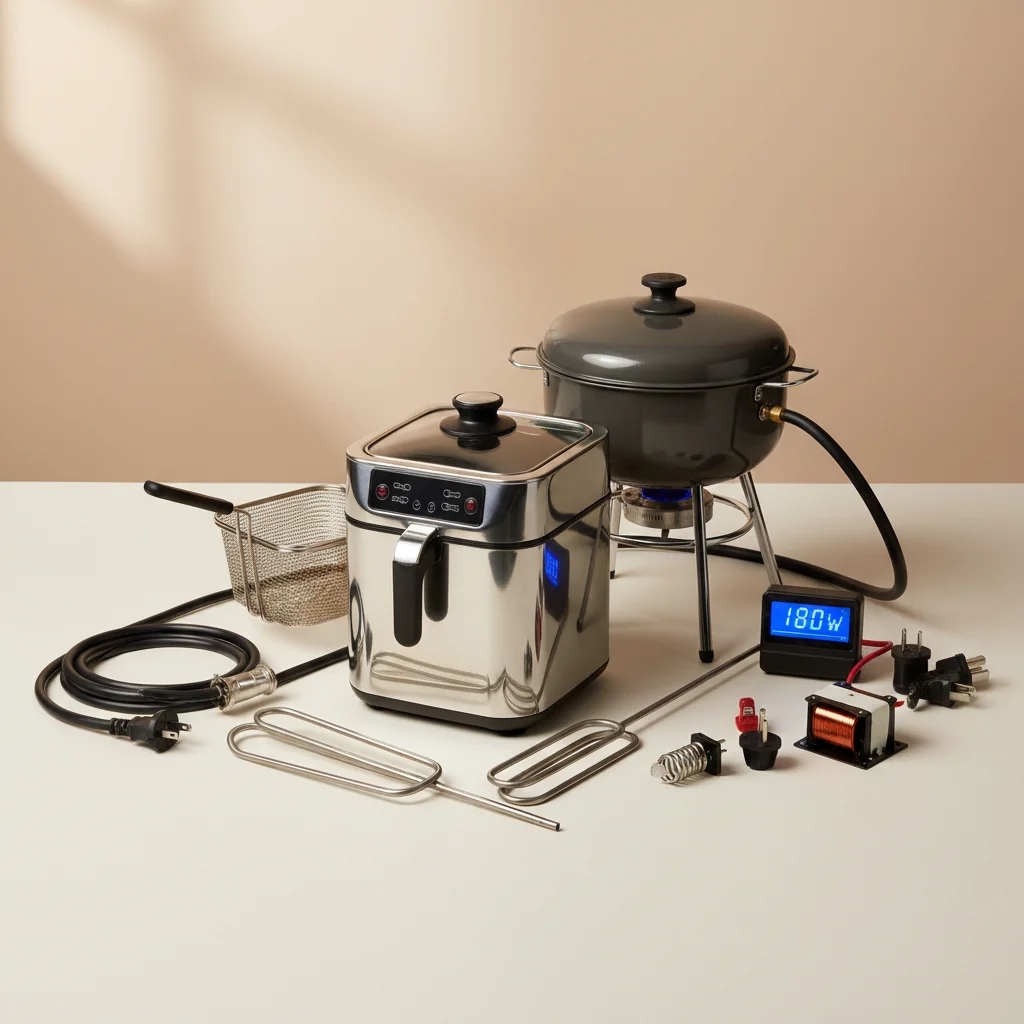
Most home deep fryers require between 1,500 and 1,800 watts for efficient and safe cooking, providing sufficient power for quick oil heating and temperature recovery. The ideal wattage for a deep fryer depends on its capacity, intended use, and your kitchen’s electrical capabilities.
Understanding Wattage and Its Impact
Wattage directly correlates with a deep fryer’s heating speed and its ability to maintain consistent oil temperatures, especially when food is added. A higher wattage generally means faster preheating times and quicker recovery after food is submerged, leading to crispier results and less oil absorption. For instance, an 1,800-watt fryer will heat oil significantly faster than a 1,200-watt model of similar capacity.
However, higher wattage also means greater power consumption. It’s important to ensure your kitchen circuits can handle the load. Most standard kitchen outlets are on 15-amp or 20-amp circuits, which can typically support appliances up to 1,800 watts without tripping breakers. Always check your fryer’s specifications and your home’s electrical capacity before purchase.
Wattage for Different Deep Fryer Sizes
The size of your deep fryer plays a significant role in determining the appropriate wattage. Smaller, compact deep fryers (1-2 liter oil capacity) often operate effectively with 1,200 to 1,500 watts. These are ideal for single servings or small batches of food.
Medium-sized deep fryers (2.5-4 liter capacity), which are common for family use, typically require 1,500 to 1,800 watts to perform optimally. For larger deep fryers (5+ liters or commercial-style units), you might see wattages ranging from 2,000 to 2,500 watts or even higher. These larger units often require dedicated circuits or 240-volt outlets, so always verify electrical requirements.
Energy Efficiency and Wattage
|
Our Picks for the Best Deep Fryer in 2026
As an Amazon Associate I earn from qualifying purchases.
|
||
| Num | Product | Action |
|---|---|---|
| 1 | Alpha Living Electric Deep Fryer – 4.5L Deep Fryer with Basket with 2-Quart and 4-Quart Baskets – High-Grade Stainless Steel – Temperature Control and Timer – Ideal for Fried Chicken, Fries |

|
| 2 | Chefman 4.5 Liter Deep Fryer w/Basket Strainer, XL Jumbo Size, Adjustable Temperature & Timer, Perfect for Fried Chicken, Shrimp, French Fries, Chips & More, Removable Oil-Container, Stainless Steel |
|
| 3 | Secura 4 Liters / 17-Cup Stainless-Steel 1700-Watt Electric Deep Fryer with Timer Free Extra Odor Filter, Triple Basket, 4.5 Quarts, Silver |
|
| 4 | Elite Gourmet Electric Deep Fryer, 4.5 Qt Total Oil Capacity (Dual 2-Qt Split Baskets), 1700 Watts, Stainless Steel, Separates Foods for Simultaneous Cooking, Stainless Steel |
|
| 5 | Hamilton Beach Electric Deep Fryer with 3 Baskets and Lid, 4.5 Liters / 19 Cups Oil Capacity, Temperature Control, View Window, Professional Style, 1800 Watts, Stainless Steel (35034) |
|
| 6 | West Bend Deep Fryer with Adjustable Temperature Control Nonstick Basket Easy-View Window and Temperature Guide, Folding Handle and Locking Cover for Easy Storage, 3-Liter, Silver |
|
| 7 | Hamilton Beach Cool Touch Electric Deep Fryer with Basket and Lid, 2 Liters / 8 Cups Oil Capacity, Adjustable Temperature, 1500 Watts for Fast Heat-up, viewing Window Easy to Clean, Black (35021) |
|
| 8 | T-fal 3.5L Stainless Steel Deep Fryer with Basket for Home Use, 1700W, Deep Fryer with Oil Filtration, Temp Control, Digital Timer |
|
| 9 | Hamilton Beach 35032 Professional Style Electric Deep Fryer, Frying Basket with Hooks, 1500 Watts, 3 Liters, Stainless Steel |
|
| 10 | Secura 4 Liters / 17-Cup Stainless-Steel 1700-Watt Electric Deep Fryer with Timer Free Extra Odor Filter, Triple Basket, 4.5 Quarts, Black |
|
While higher wattage can mean faster cooking, it doesn’t necessarily mean less energy efficiency overall. A fryer that heats up quickly and maintains temperature well might actually use less energy over the course of a cooking session than a lower-wattage model that struggles to recover heat. The key is finding a balance between power and the fryer’s insulation and design.
Look for deep fryers with good insulation and accurate thermostats. These features help retain heat and prevent the heating element from cycling on and off excessively, thus saving energy. Some models also include eco-modes or timers to further optimize energy use.
Factors Beyond Wattage to Consider
While wattage is a critical factor, it’s not the only one to consider when choosing a deep fryer. Other features contribute significantly to performance and user experience:
- Oil capacity: Match this to your typical cooking needs.
- Temperature control: Precise and consistent temperature is crucial for perfect results.
- Filtration systems: For easier oil maintenance and reuse.
- Safety features: Overheat protection, cool-touch exteriors, and magnetic power cords.
- Ease of cleaning: Removable parts and non-stick surfaces simplify cleanup.
Considering these aspects alongside wattage will help you select a deep fryer that meets all your requirements.
Recommended Wattage Ranges for Home Use
For most home cooks, a deep fryer with a wattage between 1,500 and 1,800 watts offers the best balance of performance and compatibility with standard kitchen outlets. This range provides sufficient power for frying everything from french fries to chicken wings without excessive waiting times or frequent temperature drops.
If you frequently cook large batches or plan to fry whole turkeys outdoors, you might need to explore higher wattage options, but be prepared to ensure you have the appropriate electrical setup. Always prioritize safety and consult an electrician if you are unsure about your home’s electrical capacity.
Ultimately, the right deep fryer wattage ensures your food cooks evenly and crisply, enhancing your deep-frying experience. By understanding these power requirements, you can make an informed decision that leads to delicious results every time.
Frequently Asked Questions
What is the typical wattage range for home deep fryers?
Most home deep fryers typically range from 1,500 to 1,800 watts. This wattage provides sufficient power for quick oil heating and maintaining consistent temperatures for common frying tasks.
How does higher wattage affect deep fryer performance?
Higher wattage generally leads to faster preheating times and quicker temperature recovery after food is added. For example, an 1,800-watt fryer heats oil faster than a 1,200-watt model, resulting in crispier food and less oil absorption.
Do larger deep fryers always require more wattage?
Yes, larger deep fryers typically require higher wattage to heat and maintain temperature effectively due to their increased oil capacity. Small fryers (1-2 liters) might use 1,200-1,500 watts, while large units (5+ liters) can range from 2,000-2,500 watts or more.
Is a higher wattage deep fryer less energy efficient?
Not necessarily. A higher wattage fryer that heats quickly and maintains temperature well can sometimes be more energy-efficient overall than a lower-wattage model that struggles to recover heat. Look for good insulation and accurate thermostats to optimize energy use.
What electrical considerations are important for deep fryer wattage?
It's crucial to ensure your kitchen circuits can handle the deep fryer's wattage. Most standard 15-amp or 20-amp kitchen outlets can support appliances up to 1,800 watts. Larger fryers (2,000+ watts) may require dedicated circuits or 240-volt outlets.

I’ve been deep frying for years and always preach about consistent oil temps. This article really nails why wattage is so crucial for that. My current fryer is 1700 watts and it’s a beast for maintaining heat, even when I’m doing multiple batches of tempura. It’s worth investing in a good one for those crispy, non-greasy results.
This was really helpful in understanding why my old fryer was so slow. I always thought it was just the size, but the wattage explanation makes total sense. I’m looking to get a new one for outdoor cooking and now I know to prioritize something with higher wattage for quicker recovery, especially when frying larger items like fish. Just wish some of the higher wattage models weren’t so bulky.
I used to have such a hard time getting my oil hot enough, especially when I’d drop in a big batch of wings. My old fryer was only 1200 watts and it just couldn’t keep up. Upgrading to an 1800-watt model made a huge difference. The oil heats up so much faster and stays consistent, giving me perfectly crispy results every time. No more soggy fries!
I appreciate the info on wattage, but I found that even with a 1500-watt fryer, my circuit breaker sometimes trips if I have too many other appliances running. It’s a bit of a hassle to manage. The quick heating is great, but I have to be really mindful of what else is plugged in. Maybe I need to check my kitchen’s electrical capabilities more closely.