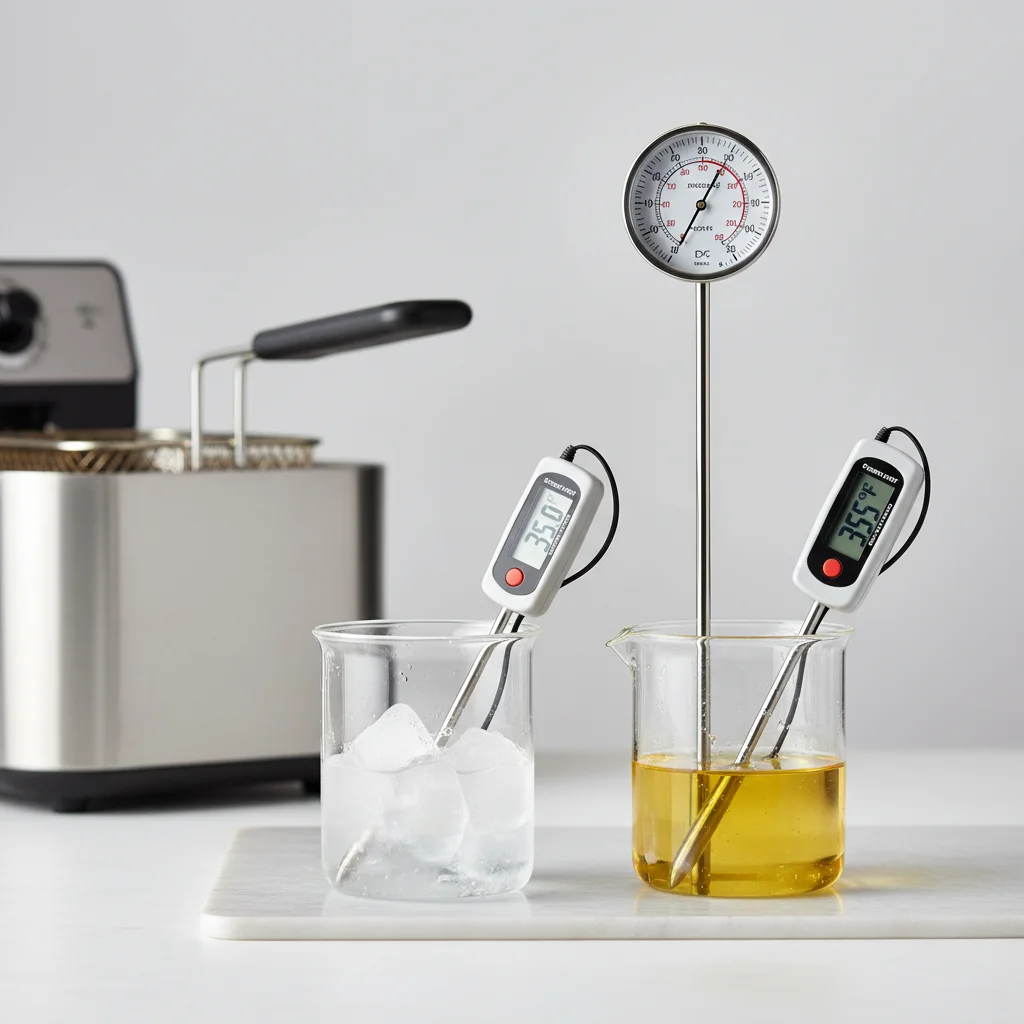
Calibrating your deep fryer thermometer is essential for safe and delicious results, and you can easily do it at home using the ice point method. This method involves checking the thermometer’s reading against the known freezing point of water, which is 32°F (0°C). Accurate calibration prevents undercooked food and avoids dangerous oil temperatures, ensuring optimal deep-frying outcomes.
Why Thermometer Accuracy Matters for Deep Frying
Accurate temperature control is the cornerstone of successful deep frying. If your oil is too cool, food will absorb excess oil and become greasy. If it’s too hot, the outside will burn before the inside cooks through, leading to an unpleasant texture and potentially unsafe consumption. An uncalibrated thermometer can lead to these issues, making calibration a vital step before each frying session, especially if you haven’t used it in a while or suspect it’s been dropped. For expert deep fryers reviews on this site.
The Ice Point Method for Calibration
The ice point method is a simple and effective way to check your thermometer’s accuracy. Fill a large glass with crushed ice and add cold tap water until the glass is full. Stir the mixture for about 30 seconds, then insert your thermometer into the ice bath, making sure the probe doesn’t touch the bottom or sides of the glass. Wait for at least 30 seconds, or until the reading stabilizes. A correctly calibrated thermometer should read 32°F (0°C). If it doesn’t, you’ll need to adjust it.
Adjusting Your Deep Fryer Thermometer
|
Our Picks for the Best Deep Fryer in 2026
As an Amazon Associate I earn from qualifying purchases.
|
||
| Num | Product | Action |
|---|---|---|
| 1 | Secura 4 Liters / 17-Cup Stainless-Steel 1700-Watt Electric Deep Fryer with Timer Free Extra Odor Filter, Triple Basket, 4.5 Quarts, Black |

|
| 2 | Hamilton Beach 35032 Professional Style Electric Deep Fryer, Frying Basket with Hooks, 1500 Watts, 3 Liters, Stainless Steel |
|
| 3 | Chefman 4.5 Liter Deep Fryer w/Basket Strainer, XL Jumbo Size, Adjustable Temperature & Timer, Perfect for Fried Chicken, Shrimp, French Fries, Chips & More, Removable Oil-Container, Stainless Steel |
|
| 4 | Alpha Living Electric Deep Fryer – 4.5L Deep Fryer with Basket with 2-Quart and 4-Quart Baskets – High-Grade Stainless Steel – Temperature Control and Timer – Ideal for Fried Chicken, Fries |
|
| 5 | Hamilton Beach Cool Touch Electric Deep Fryer with Basket and Lid, 2 Liters / 8 Cups Oil Capacity, Adjustable Temperature, 1500 Watts for Fast Heat-up, viewing Window Easy to Clean, Black (35021) |
|
| 6 | Elite Gourmet Electric Deep Fryer, 4.5 Qt Total Oil Capacity (Dual 2-Qt Split Baskets), 1700 Watts, Stainless Steel, Separates Foods for Simultaneous Cooking, Stainless Steel |
|
| 7 | Secura 4 Liters / 17-Cup Stainless-Steel 1700-Watt Electric Deep Fryer with Timer Free Extra Odor Filter, Triple Basket, 4.5 Quarts, Silver |
|
| 8 | T-fal 3.5L Stainless Steel Deep Fryer with Basket for Home Use, 1700W, Deep Fryer with Oil Filtration, Temp Control, Digital Timer |
|
| 9 | West Bend Deep Fryer with Adjustable Temperature Control Nonstick Basket Easy-View Window and Temperature Guide, Folding Handle and Locking Cover for Easy Storage, 3-Liter, Silver |
|
| 10 | Hamilton Beach Electric Deep Fryer with 3 Baskets and Lid, 4.5 Liters / 19 Cups Oil Capacity, Temperature Control, View Window, Professional Style, 1800 Watts, Stainless Steel (35034) |
|
Many deep fryer thermometers have a calibration nut or screw located just below the dial. If your thermometer reads above 32°F (0°C), gently turn the nut counter-clockwise until the needle points to the correct temperature. If it reads below 32°F (0°C), turn the nut clockwise. Some digital thermometers have a reset or recalibration button; consult your specific model’s manual for instructions. Repeat the ice bath test after adjustment to confirm accuracy.
Boiling Point Method (Optional Check)
For an additional check, you can use the boiling point method. Bring a pot of water to a rolling boil. Insert your thermometer into the boiling water, ensuring it doesn’t touch the bottom or sides. At sea level, boiling water should read 212°F (100°C). Keep in mind that boiling points decrease at higher altitudes, so adjust your expected reading accordingly (e.g., roughly 202°F at 5,000 feet). This method is a good secondary check, but the ice point method is generally sufficient for deep fryer use.
Maintaining Thermometer Accuracy
To maintain your deep fryer thermometer’s accuracy, store it in a protective sleeve or case to prevent damage. Avoid dropping it, as impacts can easily throw off its calibration. Clean the probe thoroughly after each use to prevent food residue buildup, which can affect readings. Regular calibration, ideally before each significant deep-frying session, will ensure consistent and safe cooking results. Consider investing in a high-quality, instant-read thermometer for the most reliable temperature monitoring.For those looking for a new, reliable thermometer, check out our top recommendations.
Frequently Asked Questions
Why is deep fryer thermometer accuracy important for cooking?
Deep fryer thermometer accuracy is crucial because it prevents undercooked food and avoids dangerous oil temperatures. Incorrect temperatures can lead to greasy food if too cool, or burnt exteriors with raw interiors if too hot, impacting both taste and safety.
What is the ice point method for thermometer calibration?
The ice point method involves immersing your thermometer in a mixture of crushed ice and cold water. After stirring for 30 seconds and waiting for the reading to stabilize, a correctly calibrated thermometer should display 32u00b0F (0u00b0C). This method is simple and effective for checking accuracy.
How do you adjust a deep fryer thermometer if it's inaccurate?
Many deep fryer thermometers have a calibration nut or screw below the dial. If the reading is above 32u00b0F (0u00b0C), turn the nut counter-clockwise; if below, turn it clockwise until the needle points to 32u00b0F (0u00b0C). Digital models may have a reset button, so consult the manual.
Can the boiling point method also be used to check thermometer accuracy?
Yes, the boiling point method can be used as an optional secondary check. At sea level, boiling water should read 212u00b0F (100u00b0C). However, remember that boiling points decrease at higher altitudes, so adjust your expected reading accordingly. The ice point method is generally sufficient for deep fryer use.
How often should I calibrate my deep fryer thermometer?
You should calibrate your deep fryer thermometer regularly, ideally before each significant deep-frying session. This ensures consistent and safe cooking results. Also, recalibrate if you haven't used it in a while or suspect it has been dropped, as impacts can affect its accuracy.
Calibrate Your Deep Fryer Thermometer
Calibrate your deep fryer thermometer using the ice point method to ensure accurate temperature readings for safe and delicious deep frying.
Fill a large glass with crushed ice and add cold tap water until the glass is full. Stir the mixture for about 30 seconds to ensure a consistent temperature throughout the bath.
Carefully insert your deep fryer thermometer into the ice bath. Make sure the probe does not touch the bottom or sides of the glass, as this can affect the reading. Allow the thermometer to sit for at least 30 seconds.
Wait until the thermometer's reading stabilizes. A correctly calibrated thermometer should read 32u00b0F (0u00b0C). If the reading is different, your thermometer needs adjustment.
Locate the calibration nut or screw, usually just below the dial. Gently turn the nut counter-clockwise if the reading is above 32u00b0F, or clockwise if it's below, until the needle points to the correct temperature. For digital thermometers, consult your manual for recalibration instructions.
After making adjustments, repeat the ice bath test to confirm the thermometer's accuracy. Ensure the reading consistently shows 32u00b0F (0u00b0C) before using it for deep frying.

I always just assumed my thermometer was fine, but after reading about the ice point method, I gave it a try. Turns out it was off by a few degrees! My fried chicken has been so much crispier and less greasy since I started calibrating it before each use. Definitely a game changer for getting those optimal deep-frying outcomes.
I’ve been deep frying for years, and I knew temperature control was important, but I never really thought about calibrating my thermometer regularly. The explanation about oil being too cool or too hot really hit home. My last batch of fish and chips was noticeably better after I made sure my thermometer was accurate.
The information about preventing undercooked food is spot on. I’ve had issues with that before. My only complaint is that the ice point method can be a bit fiddly to get just right, especially with a larger thermometer. Still, it’s better than guessing and ending up with burnt exteriors.