A deep fryer that refuses to heat up can bring your kitchen to a frustrating halt, especially when you’re craving crispy, golden delights. This common issue, while annoying, often stems from relatively simple problems that you can troubleshoot and fix yourself with a bit of patience and the right approach. Instead of rushing to buy a new appliance or calling an expensive repair service, understanding the basic components and a few DIY steps can often restore your deep fryer to perfect working order, saving you time and money. This guide will walk you through the essential diagnostics and repairs, empowering you to get your fryer hot and ready for action.
Safety First: Essential Precautions Before Any Repair
Before you even think about troubleshooting or repairing your deep fryer, safety must be your absolute priority. Working with electrical appliances, especially those that deal with high heat and oil, carries inherent risks. Always follow these crucial safety steps to protect yourself from injury and prevent further damage to your appliance.
First and foremost, unplug your deep fryer from the wall outlet. Confirm that there is absolutely no power running to the unit. Allow the fryer to cool down completely; hot oil or internal components can cause severe burns. Wear protective gloves if you suspect contact with any sharp edges or residue. Never attempt to work on a deep fryer that is still plugged in or hot. Ensure your workspace is clean, dry, and well-lit to prevent accidents.
Understanding Your Deep Fryer’s Heating System
To effectively troubleshoot a deep fryer that isn’t heating, it helps to understand how it typically operates. Electric deep fryers are relatively straightforward appliances designed to heat oil to a precise temperature for frying. This process involves several key components working in unison.
At its core, the heating element is responsible for generating the heat. This metal coil, often submerged directly in the oil, converts electrical energy into thermal energy. The thermostat acts as the brain of the operation, monitoring the oil temperature and signaling the heating element to turn on or off to maintain your set temperature. For safety, deep fryers also include a thermal fuse or high-limit reset button, which automatically cuts power if the temperature exceeds a safe limit, preventing overheating and potential fires. Understanding these components is the first step in diagnosing why your deep fryer might be failing to heat.
Initial Troubleshooting: Simple Checks You Can Do
When your deep fryer stops heating, don’t immediately assume the worst. Often, the problem lies with simple, easily overlooked issues. Start with these basic checks before diving into more complex diagnostics.
Power Supply: Outlet, Cord, and Breaker
|
Our Picks for the Best Deep Fryer in 2026
As an Amazon Associate I earn from qualifying purchases.
|
||
| Num | Product | Action |
|---|---|---|
| 1 | Secura 4 Liters / 17-Cup Stainless-Steel 1700-Watt Electric Deep Fryer with Timer Free Extra Odor Filter, Triple Basket, 4.5 Quarts, Silver |

|
| 2 | Secura 4 Liters / 17-Cup Stainless-Steel 1700-Watt Electric Deep Fryer with Timer Free Extra Odor Filter, Triple Basket, 4.5 Quarts, Black |
|
| 3 | Alpha Living Electric Deep Fryer – 4.5L Deep Fryer with Basket with 2-Quart and 4-Quart Baskets – High-Grade Stainless Steel – Temperature Control and Timer – Ideal for Fried Chicken, Fries |
|
| 4 | West Bend Deep Fryer with Adjustable Temperature Control Nonstick Basket Easy-View Window and Temperature Guide, Folding Handle and Locking Cover for Easy Storage, 3-Liter, Silver |
|
| 5 | Chefman 4.5 Liter Deep Fryer w/Basket Strainer, XL Jumbo Size, Adjustable Temperature & Timer, Perfect for Fried Chicken, Shrimp, French Fries, Chips & More, Removable Oil-Container, Stainless Steel |
|
| 6 | Hamilton Beach Electric Deep Fryer with 3 Baskets and Lid, 4.5 Liters / 19 Cups Oil Capacity, Temperature Control, View Window, Professional Style, 1800 Watts, Stainless Steel (35034) |
|
| 7 | Hamilton Beach 35032 Professional Style Electric Deep Fryer, Frying Basket with Hooks, 1500 Watts, 3 Liters, Stainless Steel |
|
| 8 | T-fal 3.5L Stainless Steel Deep Fryer with Basket for Home Use, 1700W, Deep Fryer with Oil Filtration, Temp Control, Digital Timer |
|
| 9 | Elite Gourmet Electric Deep Fryer, 4.5 Qt Total Oil Capacity (Dual 2-Qt Split Baskets), 1700 Watts, Stainless Steel, Separates Foods for Simultaneous Cooking, Stainless Steel |
|
| 10 | Hamilton Beach Cool Touch Electric Deep Fryer with Basket and Lid, 2 Liters / 8 Cups Oil Capacity, Adjustable Temperature, 1500 Watts for Fast Heat-up, viewing Window Easy to Clean, Black (35021) |
|
Begin by inspecting the power source. Is the deep fryer securely plugged into a functioning wall outlet? Try plugging another appliance into the same outlet to confirm it has power. If the outlet is dead, check your home’s electrical panel for a tripped circuit breaker and reset it if necessary. Also, visually inspect the deep fryer’s power cord for any visible damage, such as fraying, cuts, or burn marks. A damaged cord can prevent power from reaching the heating element.
Thermostat Settings: Correct Temperature and Function
An incorrect thermostat setting is a surprisingly common reason for a fryer not heating. Ensure the thermostat dial or digital control is set to the desired cooking temperature, typically between 325°F and 375°F. If the setting is too low, the element may not activate. You can use an external thermometer to compare the actual oil temperature with the fryer’s reading to check for discrepancies, which might indicate a calibration issue or a failing thermostat.
Safety Reset Button: Locate and Reset
Most deep fryers are equipped with a high-limit safety reset button designed to trip and cut power if the oil overheats or if the oil level is too low. This is a crucial safety feature. After ensuring the fryer has cooled down and the oil level is adequate, locate this button (often recessed on the control panel, underneath the unit, or on the heating element assembly). Use a narrow object like a pen tip or paper clip to press it firmly until you hear a click. This often restores power.
Oil Level and Quality: Adequate Oil and Freshness
Operating a deep fryer with insufficient oil can cause it to stop heating or trip the safety switch, protecting the heating element from damage. Always ensure the oil is filled to the recommended minimum level, as indicated by markings inside the fryer. Additionally, old or degraded oil can affect heating efficiency and overall performance. If your oil is dark, smoking excessively, or has a strong odor, it might be time for a change.
Cleanliness: Grease Buildup and Food Particles
Over time, grease and food particles can accumulate on the heating element and within the fryer’s interior. This buildup can act as an insulator, preventing the heating element from efficiently transferring heat to the oil. A thorough cleaning, especially around the element, can sometimes resolve heating issues. Ensure the fryer is completely cool and unplugged before cleaning, using appropriate degreasers and soft brushes.
Diagnosing Deeper Problems with a Multimeter
If the basic checks haven’t resolved the issue, it’s time to delve deeper into the electrical components. A multimeter is an invaluable tool for testing continuity and resistance in various parts of your deep fryer. Remember to always disconnect power before performing any tests.
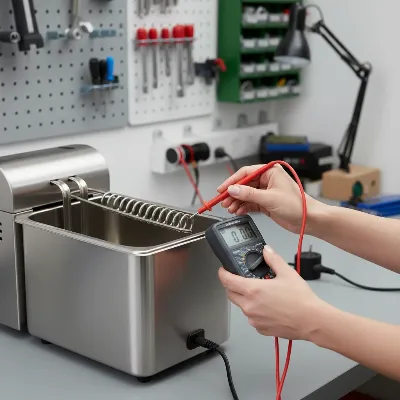 Technician testing deep fryer heating element with a multimeter for continuity
The Heating Element: Testing for Continuity
The heating element is a common point of failure. If the fryer powers on but the oil remains cold, the heating element is a prime suspect. To test it:
- Disconnect the element: Unplug the fryer and carefully remove the heating element assembly from the unit.
- Set your multimeter: Switch your multimeter to the ohms (Ω) setting, which measures resistance.
- Test for continuity: Touch one probe to each terminal of the heating element.
- Normal Reading: A healthy heating element will typically show a resistance reading between 10 and 30 ohms.
- Very Low or Zero Ohms: This indicates a short circuit within the element, meaning it’s faulty.
- Infinite Resistance (Open Circuit/OL): This means the circuit is broken, and the element is completely dead.
If your heating element shows a reading outside the normal range, it needs to be replaced. Look for visible signs of damage, like bulges, cracks, or heavy corrosion, which also indicate a faulty element.
| Multimeter Reading | Indication | Action Required |
|---|---|---|
| 10-30 Ohms | Healthy Element | Element is okay |
| ~0 Ohms (Short) | Internal Short Circuit | Replace Element |
| OL / Infinite Ohms | Open Circuit (No Current) | Replace Element |
The Thermostat: How It Works and Testing
The thermostat regulates the oil temperature by turning the heating element on and off. A malfunctioning thermostat can lead to inconsistent heating or no heat at all.
- Locate and access: After unplugging the fryer, you’ll need to locate and carefully access the thermostat, usually found near the heating element or control panel.
- Test for continuity: Set your multimeter to the continuity setting (often indicated by an audible beep or a diode symbol). With the thermostat set to a high temperature, touch the multimeter probes to the thermostat’s terminals.
- Good Thermostat: The multimeter should show continuity (a beep or a low resistance reading).
- Faulty Thermostat: If there’s no continuity, the thermostat is likely broken and not allowing current to pass through, even when set to heat.
If the thermostat fails the continuity test, it will need to be replaced. Replacing a deep fryer thermostat often involves carefully disconnecting wires and removing a sensing bulb that extends into the oil well. Pay close attention to how wires are connected before removal.
The Thermal Fuse: A One-Time Safety Device
A thermal fuse is a safety component designed to blow (open the circuit) permanently if the temperature inside the fryer exceeds a dangerous threshold, often due to a primary thermostat failure or severe overheating. Unlike a reset button, a blown thermal fuse cannot be reset; it must be replaced.
- Locate the fuse: The thermal fuse is usually a small, cylindrical component wrapped in a protective sleeve, often located near the heating element or wiring.
- Test for continuity: With the multimeter on the continuity setting, touch one probe to each end of the fuse.
- Good Fuse: The multimeter should show continuity (a beep or a very low resistance).
- Blown Fuse: If there is no continuity, the fuse is blown and needs replacement.
Replacing a thermal fuse requires careful wiring and often soldering. Ensure you replace it with a fuse of the exact same temperature rating and amperage. A blown thermal fuse often indicates an underlying issue that caused the overheating; consider why it tripped.
Essential Tools for Deep Fryer Repair
Having the right tools makes troubleshooting and repair much easier and safer. For most DIY deep fryer fixes, you’ll likely need:
- Screwdrivers: Philips and flathead, for opening panels and disconnecting terminals.
- Multimeter: Absolutely essential for testing electrical components like heating elements, thermostats, and fuses.
- Needle-nose pliers: Useful for grasping small wires and components.
- Wire strippers: If you need to replace any wiring or thermal fuses.
- Heat-resistant gloves: For protection, especially if working near recently cooled components.
- External thermometer: To verify oil temperature independently of the fryer’s thermostat.
- Cleaning supplies: Degreaser, brushes, and cloths for thorough cleaning.
When to Call a Professional or Consider Replacement
While many deep fryer issues are fixable through DIY efforts, there are times when calling a professional or considering a new unit is the smarter choice. If you’ve tried all the troubleshooting steps and the deep fryer still isn’t heating, or if you’re uncomfortable working with electrical components, it’s best to seek expert help.
Visible damage to internal wiring, persistent tripping of your home’s circuit breaker, or complex repairs involving gas lines (for gas fryers) should always be handled by a qualified technician. If the repair cost approaches or exceeds the price of a new deep fryer, or if the unit is very old and frequently malfunctioning, investing in a replacement might be more cost-effective in the long run. Safety should never be compromised for the sake of a DIY fix.
Preventative Maintenance for Longevity
Regular maintenance is key to preventing most deep fryer heating problems and extending the life of your appliance. Simple habits can make a significant difference.
Always keep your deep fryer clean, regularly draining and filtering the oil, and thoroughly scrubbing the oil well and heating element to prevent grease and food particle buildup. Ensure you’re using fresh, high-quality oil and always fill it to the recommended level. Periodically inspect the power cord for damage and ensure the thermostat knob operates smoothly. By dedicating a little time to routine care, you can often avoid the frustration of a deep fryer that won’t heat up.
Conclusion
Facing a deep fryer that won’t heat up can be a real kitchen dilemma, but as you’ve seen, many common culprits can be identified and fixed with a bit of DIY know-how. From basic power checks and resetting safety switches to more in-depth diagnostics with a multimeter, empowering yourself with these troubleshooting skills can save you both time and money. Remember that safety is paramount, always unplugging the unit and ensuring it’s cool before any intervention. Regular maintenance also plays a crucial role in preventing these issues from arising in the first place, keeping your deep fryer performing optimally for countless batches of delicious food. Don’t let a cold fryer dampen your culinary spirits; with these steps, you’ll likely have it sizzling again in no time. What delicious fried creation will you tackle first once your deep fryer is back in action?
Frequently Asked Questions
Why does my deep fryer turn on but not heat up the oil?
If your deep fryer powers on but the oil remains cold, the most common causes are a faulty heating element or a malfunctioning thermostat. The heating element might have an open circuit, or the thermostat could be failing to signal the element to activate. Testing these components with a multimeter can help pinpoint the exact issue for a quick DIY repair.
How do I reset the safety switch on my deep fryer?
To reset the safety switch, first, unplug your deep fryer and allow it to cool completely. Locate the recessed reset button, often found on the control panel, underneath the unit, or near the heating element. Use a narrow object like a pen or paper clip to press it firmly until you hear a click, then reassemble and test the fryer.
Can low oil level prevent a deep fryer from heating?
Yes, a low oil level can absolutely prevent your deep fryer from heating. Most deep fryers have a minimum oil level requirement for safe operation. If the oil is below this line, a safety sensor might prevent the heating element from activating, or a high-limit switch could trip to prevent element damage.
What resistance should a deep fryer heating element show on a multimeter?
A healthy deep fryer heating element typically shows a resistance reading between 10 and 30 ohms when tested with a multimeter. A reading near zero ohms indicates a short circuit, while an “OL” or infinite resistance signifies an open circuit, both meaning the element is faulty and needs replacement.
Is it safe to replace a deep fryer’s thermal fuse myself?
Replacing a thermal fuse can be a DIY task if you are comfortable with basic electrical work and soldering. It’s crucial to replace it with a fuse of the exact same temperature and amperage rating. However, remember that a blown thermal fuse often indicates an underlying overheating issue that should also be addressed to ensure safety.
How often should I clean my deep fryer to prevent heating issues?
Regular cleaning is vital for deep fryer longevity and preventing heating issues. For frequent users, draining, filtering, and cleaning the oil well and heating element after every few uses is recommended. A thorough deep clean should be performed regularly, ideally every few weeks or months, depending on usage frequency.
